Introduction
Organisms with a long evolutionary history are a valuable source of bioactive molecules that can be used in various sciences. Organisms produce a variety of biomolecules, including immune systems, different enzymes, and primary and secondary metabolites that have evolved over millions of years in order to survive in the diverse environments which they encounter. Industrialization, increasing pollutants, changing lifestyles and poor eating habits have left modern humans with major problems such as poor nutrition and multiple illnesses. The existence of these problems has led researchers to find and build compounds that can play a positive role in reducing these problems, inspired by nature and the use of various biological resources. Today, in the developing countries, special attention has been paid to the use of natural resources (Bioresource) to extract special bioactive products, small, powerful, energetic and functional. Therefore, bioactive compounds and natural products, including a wide range of molecules and macromolecules, have very diverse properties that human beings deal with directly and indirectly. Such as pharmaceutical properties, fragrances, pigments, cosmetics, antibiotics, anticancer compounds, antioxidants, dietary supplements, functional food, useful pharmaceutical and industrial enzymes, bioactive peptides are applications of these compounds. Most of these compounds are used in the treatment of diseases such as cancer, diabetes; allergies, inflammation and hypertension, and some are used in the food industry as stabilizers, thickeners, emulsifiers, fat-reducing agents and film-forming agents.
Aims
The aims of the present interdisciplinary research group include the use of various specialties and trends related to bioactive compounds with natural or synthetic origins. A wide range of related activities include the discovery or production of bioactive compounds from natural resources and their recombinant methods, extraction, analysis, structure determination, engineering and manipulation of them from small to macromolecules and from four major sources. There are a wide range of related activities including the discovery or production of bioactive compounds both from natural resources and recombinant modification methods, extraction, analysis, structure determination, engineering, and manipulation of them. Since Iran is very resourceful and has a rich and diverse source of such materials in four categories:
1- animals (onshore and offshore),
2- land and sea plants,
3- insects and arthropods, and
4- microorganisms that can be investigated, and work on their industrialization, formulation and commercialization.
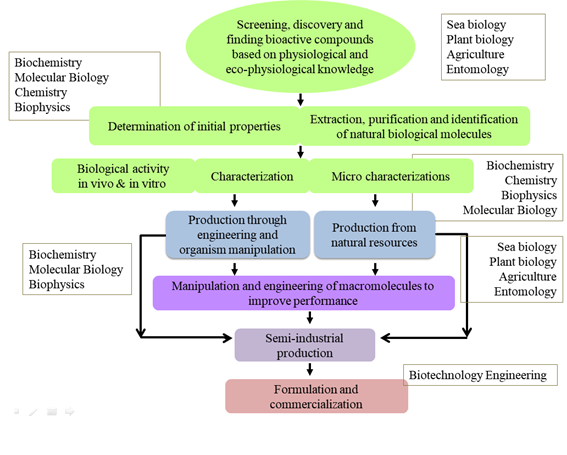
The general program of this interdisciplinary group, along with the specializations related to each of the work steps, is given in the following flowchart.
Missions
-
Creating a coherent science and technology team to identify, study and produce bioactive compounds based on country priorities
-
Complete the production cycle of bioactive compounds with a commercialization perspective
-
Training of specialists in the field of bioactive compounds production with an industrial perspective
-
Identification of specific compounds and determination of their biological properties from the specific organisms of Iranian ecosystems
-
Create knowledge-based start-ups
Plans
The present program seeks to identify bioactive molecules and macromolecules from different bio-sources of the country and to investigate their use in agriculture, medicine and food industry, cosmetics, etc.
Given the interdisciplinary nature of the program, it is necessary to provide the appropriate platforms to bring researchers together from diverse disciplines and expertise. As a part of co-ordinated interdisciplinary research team, they will begin to study the identification, extraction and exploitation of bioactive molecules from various sources as well as their production engineering. This is a hot an innovative approach that today is being exploited in the industrialized world especially with the motto of zero waste idea. This mega trend received much more attention since 2003 with the idea of convergence of four newly emerging fields (NBIC, Nanotechnology, Biotechnology, Information technology and Cognitive science) and from 2010 in the framework convergence of science and technology for the benefit of society. There has been a lot of investment in this area, especially in the US, Europe, China, Japan and South Korea, with a new and innovative approaches.
Based on the above, the bioactive materials group aims to research with a practical approach and with the focus on creating a coherent scientific and technological team on identifying, studying and producing bioactive compounds based on the countrys priorities, completing their production cycle with a commercialization view. The training of experts in the field of bioactive compounds production with an industrial perspective, identification of specific compounds and determination of their biological properties were formed from organisms specific to the Iranian ecosystem. The primary goals of this group are outlined in the field of identification, development of technical knowledge and production of bioactive compounds from native bio-Iranian resources and action to commercialize them with emphasis on antioxidant and anti-cancer properties. The aligning of this program with the countrys macro-policies justifies the formation of this group at Tarbiat Modares University.
Interdisciplinary team members
-
Dr. Hossein Naderi-Manesh, Professor, Faculty of Biological Sciences, Department of Biophysics and Nanotechnology, Principal investigator (PI)
-
Dr. Saman Hosseinkhani, Professor, Faculty of Biological Sciences, Department of Biochemistry, Principal investigator (PI)
-
Dr. Mohsen Barzegar, Professor, School of Agriculture, Food Science and Technology Department, Principal investigator (PI)
-
Dr. Reza H. Sajedi, Associate Professor, Faculty of Biological Sciences , Department of Biochemistry, Principal investigator (PI)
-
Dr. Mohsen Sharifi, Associate Professor, Faculty of Biological Sciences, Department of Plant Sciences, Principal investigator (PI)
-
Dr. Saber Khodabandeh, Associate Professor, Natural Resources and Marine Sciences-Marine Biology Department, Principal investigator (PI)
-
Dr. Valiollah Babaipour, Associate Professor, Malek Ashtar University of Technology-Department of Biochemical Engineering, Principal investigator (PI)
-
Dr. Mohammad Mehrabadi, Assistant Professor, Agriculture-Entomology, Principal investigator (PI)
-
Dr. Mehdi Tabarsa, Assistant Professor, Natural Resources and Marine Sciences-Marine Biology Department, Principal investigator (PI)
-
Dr. Zahra Vaezi, Department of Bioactive Compounds, Interdisciplinary Faculty, Group coordinator.
|


